The Myth of 'Old Tech'

The Myth of 'Old Tech'

Is Hyper-V Dead????

“Hyper-V? That’s legacy tech. It can’t compete with VMware.” I’ve heard this sentiment more times than I can count. In hallway conversations at conferences, in architecture review meetings, in vendor comparison spreadsheets filled with red X marks in the Hyper-V column. For years, this perception has been the default position—sometimes justified, often not. In this third post of the Hyper-V Renaissance series, we’re going to dismantle this myth systematically. Not with marketing claims, but with verified specifications, feature-by-feature comparisons, and honest assessments of where Hyper-V excels and where it still trails.
Odin for Azure Local: A Community Tool Deep Dive

Odin for Azure Local: A Community Tool Deep Dive

The Optimal Deployment and Infrastructure Navigator

I’m in the middle of writing The Hyper-V Renaissance—an 18-part series making the case for traditional Hyper-V with Windows Server 2025 as a serious virtualization platform. It’s been consuming most of my writing time, and I’ve been heads-down on TCO comparisons, cluster builds, and PowerShell automation. But sometimes you stumble across something that deserves its own post, and you have to step away from the main project for a minute.
The Real Cost of Virtualization

The Real Cost of Virtualization

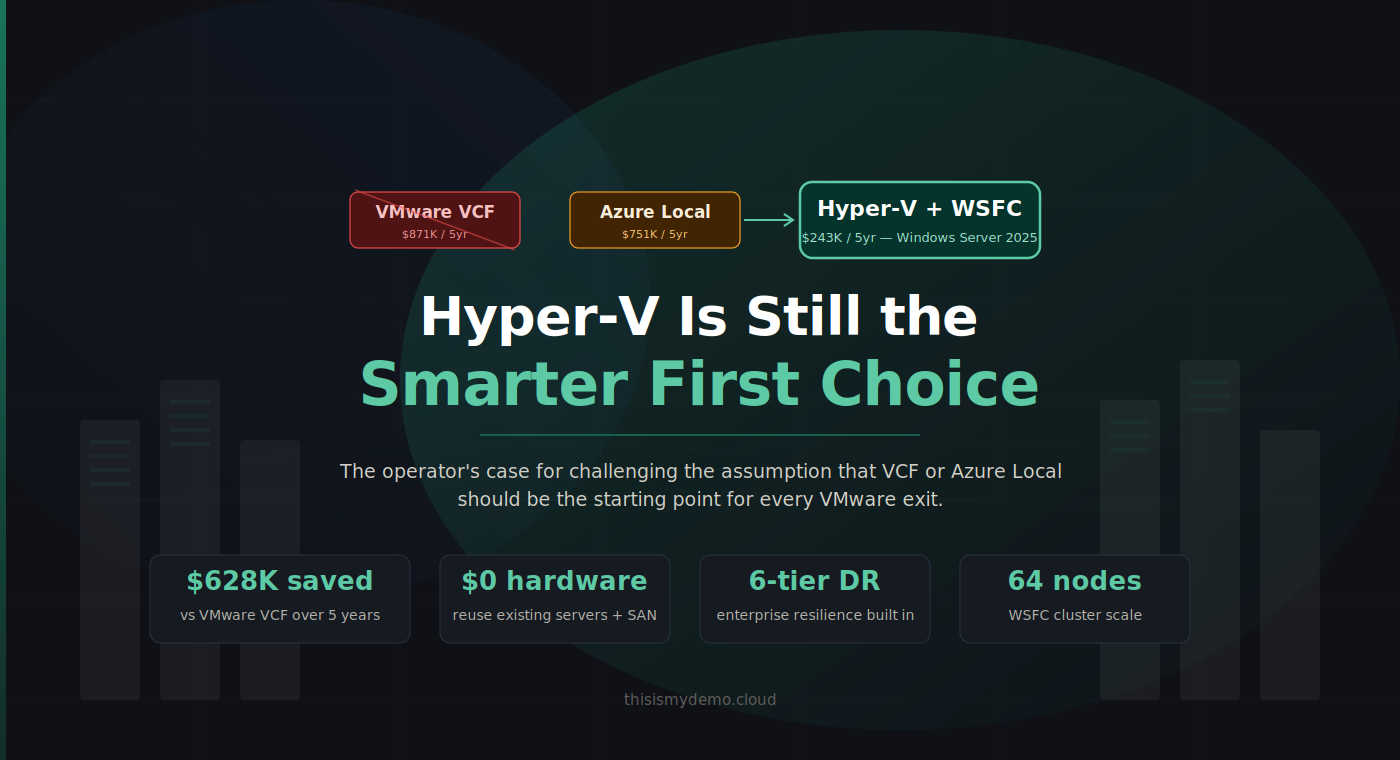
TCO Comparison - VMware, Azure Local, and Hyper-V

The invoice arrived, and the meeting quickly followed. For nearly two decades, the “cost of virtualization” was a line item we grumbled about but accepted. It was the “VMware Tax,” the price of admission for a stable, feature-rich datacenter. But in the wake of the Broadcom acquisition and the subsequent licensing overhaul, that tax has, for many organizations, turned into a ransom. This isn’t just about price hikes. It’s about a fundamental shift in how infrastructure is consumed.
Welcome to the Hyper-V Renaissance

Welcome to the Hyper-V Renaissance

Why It's Time to Reevaluate Microsoft's On-Prem Champion

Introduction A Perfect Storm Creates Opportunity If you’ve been watching the virtualization market over the past eighteen months, you’ve witnessed something extraordinary: a once-stable industry thrown into chaos by a single acquisition. When Broadcom completed its $69 billion purchase of VMware in November 2023, few anticipated how dramatically—and rapidly—the landscape would shift. What followed wasn’t just a pricing adjustment; it was a fundamental restructuring that has sent shockwaves through data centers worldwide.
VMware vSphere to Azure Local: Operator Feature Mapping

VMware vSphere to Azure Local: Operator Feature Mapping

This blog is for admins and operators: a practical, side‑by‑side mapping from what you did in vSphere (vMotion, DRS, snapshots, SRM, NSX, vCenter) to what you’ll use in Azure Local (Live Migration, Failover Clustering, checkpoints, ASR/Hyper‑V Replica, WAC/Azure Portal).

From VMware vSphere to Azure Local: What Changes and Where to Click The industry shift away from VMware has accelerated dramatically. Organizations worldwide are evaluating alternatives, driven by licensing changes, acquisition uncertainty, and evolving business needs. For many enterprises, this transition represents both a significant operational challenge and a strategic opportunity to modernize their virtualization infrastructure. This blog addresses the practical reality facing infrastructure teams: when organizational decisions mandate a platform change, success depends on understanding exactly how daily operations translate to the new environment.
Comparing AI: A fun test of AI capabilities

Comparing AI: A fun test of AI capabilities

What happens when you throw the same chaotic brain dump at five different AI models? Join me for an entertaining battle royale between OpenAI GPT-4.5, Google Gemini 2.5 Pro, Claude Sonnet 4, Grok AI, and Microsoft Copilot as they attempt to decode my scattered thoughts about GitHub Copilot Chat configuration. It's like 'The Hunger Games' but for artificial intelligence!

Welcome to My AI Battle Royale! 🥊 Picture this: I’m sitting at my desk, drowning in my own scattered thoughts about GitHub Copilot Chat configurations, when I had what can only be described as a “brilliant” idea. Why not throw my messy brain dump at some of the world’s most advanced AI models and see who comes out on top? So here we are – welcome to my completely unscientific, totally biased, but hopefully entertaining comparison of AI capabilities!
Beyond the Cloud: Feature Face-Off - Part IV

Beyond the Cloud: Feature Face-Off - Part IV

Broadcom's VMware acquisition changed the game—not just pricing, but the entire virtualization landscape. This deep-dive comparison reveals that Windows Server 2025 delivers 90% of VMware's capabilities at 30% of the cost—but the devil is in the remaining 10%.

The Enterprise Reality Check As we’ve established in previous posts, the post-Broadcom VMware landscape has fundamentally shifted the conversation around enterprise virtualization. No longer can organizations simply renew their vSphere licenses and move on—pricing has increased dramatically, licensing models have changed, and many customers are being pushed toward VMware Cloud Foundation whether they need all its components or not. But beyond cost considerations lies a critical question: Does Windows Server Failover Clustering with Hyper-V actually deliver the enterprise features that keep VMware entrenched in so many data centers?
Beyond the Cloud: Hardware Considerations - Part III

Beyond the Cloud: Hardware Considerations - Part III

Your VMware exit hardware strategy determines both timeline and budget. Windows Server offers maximum flexibility with existing infrastructure, Azure Local requires validated nodes costing $200K-500K+, and VMware VCF 9.0 deprecates older hardware anyway. This analysis provides a framework for making hardware decisions that fit your organization's timeline and budget constraints.

(Note: AVS – Azure VMware Solution – is not covered in detail here since it’s essentially outsourcing VMware onto Azure’s hardware. That involves a different calculus: you avoid buying hardware entirely, but you pay cloud rental fees and must fit into Azure’s instance constraints. In this post, we focus on on-premises alternatives where you control the hardware.) Hardware Considerations: Build Your Cloud on Your Terms Series Recap: In Part 1 of this series, we examined the total cost of ownership (TCO) implications of different post-VMware paths, comparing capital expenditure vs.
Beyond the Cloud: 2025 Virtualization Licensing Guide - Part II

Beyond the Cloud: 2025 Virtualization Licensing Guide - Part II

Virtualization licensing just got complicated. With VMware's Broadcom acquisition driving 3x cost increases and Microsoft introducing new subscription models, IT leaders need a clear roadmap. This blog provides the analysis and insights you need to make informed decisions that align with your budget and strategy.

Welcome to Part 2 of our “Beyond the Cloud: The Case for On-Premises Virtualization” series. In our introductory post, we explored why organizations are reconsidering their virtualization strategies post-VMware acquisition. In Part 1, we conducted a detailed five-year Total Cost of Ownership (TCO) analysis comparing Windows Hyper-V, Azure VMware Solution (AVS), and Azure Local, revealing how different cost structures impact long-term budgets. A key factor driving those cost differences was how each platform’s licensing model works.
Beyond the Cloud: CapEx vs Subscription TCO Analysis - Part I

Beyond the Cloud: CapEx vs Subscription TCO Analysis - Part I

Which stack is cheapest over five years for a 100 VM footprint? A detailed TCO analysis of Hyper-V, Azure VMware Solution, and Azure Local.

Introduction In our previous blog post, we explored why organizations are reconsidering their virtualization strategy post-VMware and highlighted the often-overlooked value of Windows Server Failover Clustering with Hyper-V. Now, in this first follow-up post of the "Beyond the Cloud: The Case for On-Premises Virtualization" series, we dive into the financial side of that decision. Specifically, we will compare the five-year Total Cost of Ownership (TCO) for three possible platforms to run a 100-Virtual Machine (VM) workload: