Azure Local

This Week's Hagrid: Carsten Rachfahl

This Week's Hagrid: Carsten Rachfahl

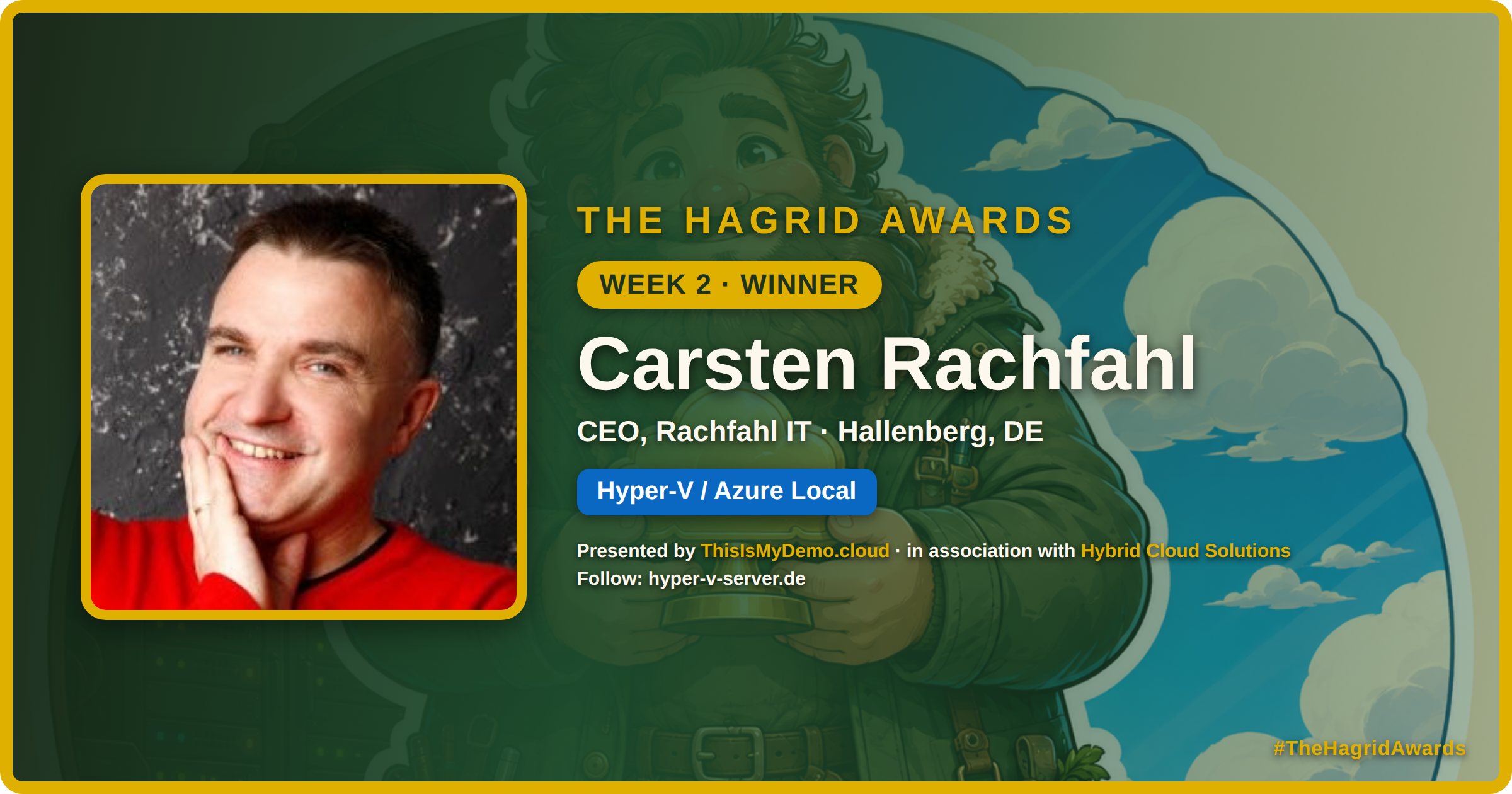
Week 2 of The Hagrid Awards goes to Carsten Rachfahl — a one-person Hyper-V and Azure Local broadcast network, and MVP since 2010.

This week’s Hagrid goes to Carsten Rachfahl.

Carsten has been a pillar of the hybrid community for over a decade — a blog, a YouTube channel, the German Microsoft Virtualisierungs Podcast, and the Hyper-V Amigos. A one-person Azure Local and Hyper-V broadcast network. MVP since 2010.

This Week's Hagrid: Darryl van der Peijl

This Week's Hagrid: Darryl van der Peijl

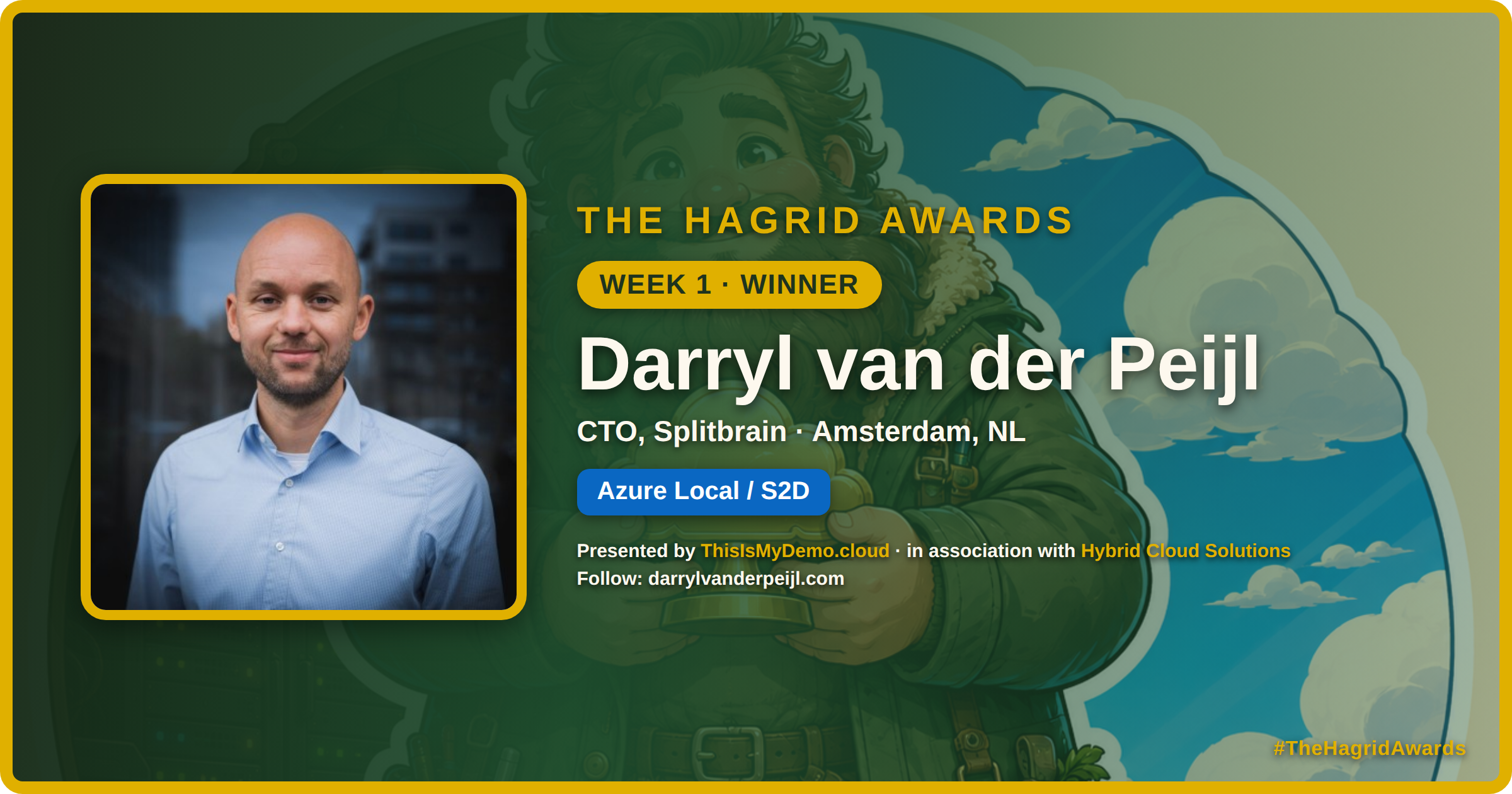
Week 1 of The Hagrid Awards goes to Darryl van der Peijl — the connective tissue of the Azure Local community.

This week’s Hagrid goes to Darryl van der Peijl.

If you run anything Azure Local, you already know Darryl. He runs the community Azure Local Slack and the monthly Azure Local Insider newsletter — the connective tissue of this community, where people share what’s new, what’s broken, and what’s next. He’s a 12x Microsoft MVP and CTO at Splitbrain. He’s also the brains behind the Hybrid Platform Conference — a one-day Azure Local & hybrid cloud event in Amsterdam (Sept 28, 2026 at Hotel Casa), with a free virtual edition to follow.

Introducing The Hagrid Awards: Celebrating the Hybrid Cloud Community

Introducing The Hagrid Awards: Celebrating the Hybrid Cloud Community

A weekly, public thank-you to the people building and sharing in the Azure Local, Hyper-V, and Azure Arc community.

First, about that nickname

If you’ve met me at an event, you already know the beard. And you probably know that somewhere along the way, people in this community started calling me Hagrid. I’ve leaned into it — a big, bearded guy who loves keeping things running on the ground and in the cloud. Honestly, it fits. Hagrid was the Keeper of Keys and Grounds, and that’s basically what we all do in hybrid: keep one foot on-prem and one foot in Azure.

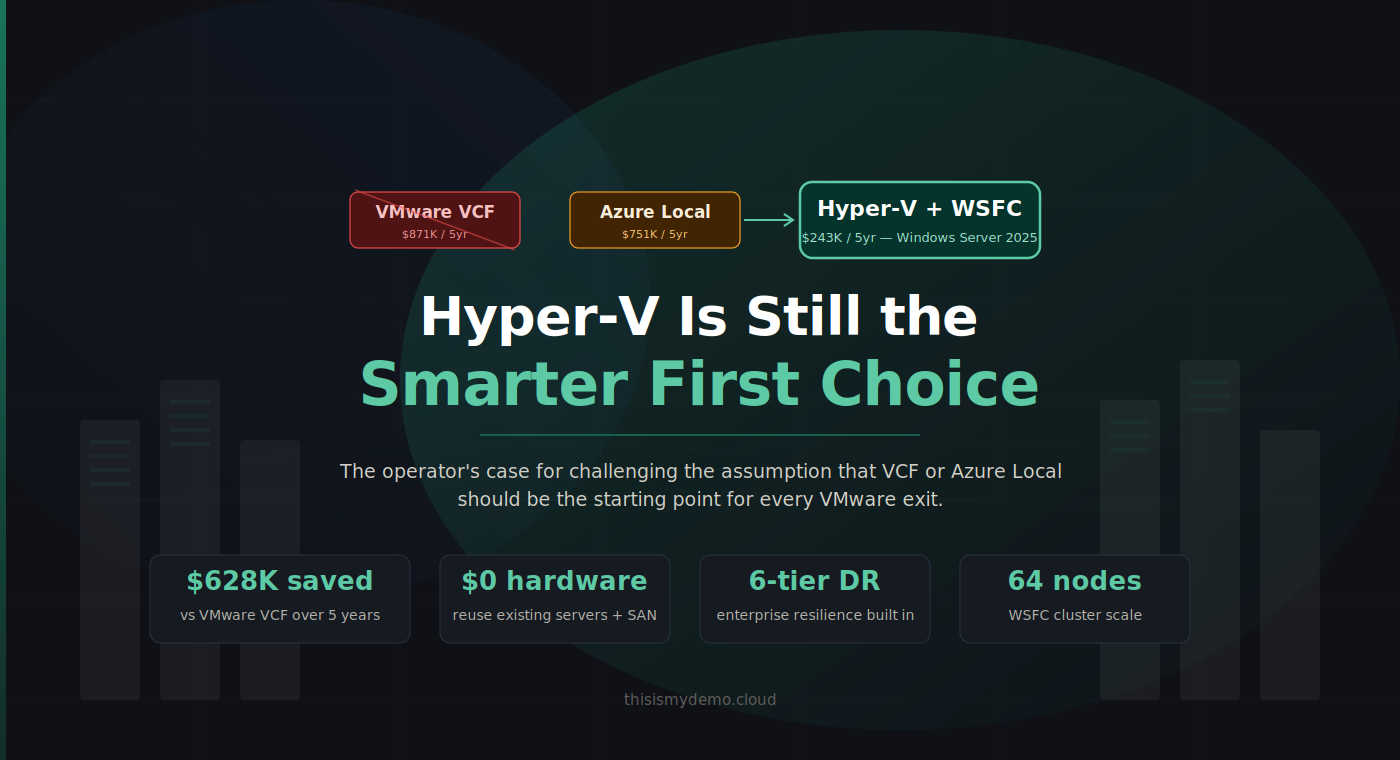
Hyper-V Is Still the Smarter First Choice

Hyper-V Is Still the Smarter First Choice

The operator's case for challenging the assumption that VCF or Azure Local should be the starting point for every VMware exit.

Azure Local is not the default VMware exit path. Neither is VMware Cloud Foundation the unquestioned benchmark it was two years ago. And yet the industry keeps framing the VMware exodus as a binary choice: stay and pay, or move to Microsoft’s preferred Azure-connected platform. Both options serve somebody’s agenda. Neither starts from the question that actually matters to infrastructure operators: what do I need, and what’s the cheapest way to get it without creating new dependencies?

What Was Under Your Nose All Along

What Was Under Your Nose All Along

Why Hyper-V Often Fits Better Than VCF 9 or Azure Local

The series started with a simple question: if so many organizations are unhappy with the VMware commercial path they are on, where should they go next?

After twenty posts, the answer is clearer than ever.

For a lot of organizations, the right answer is not “stay where you are and absorb the bill.” It is also not automatically “move to Azure Local because it is Microsoft’s newest answer.” The right answer is often the platform that has been in the rack, in the OS, and in the skill set for years: Hyper-V on Windows Server 2025.

S2D vs. Three-Tier and When Azure Local Makes Sense

S2D vs. Three-Tier and When Azure Local Makes Sense

The Honest Comparison , Performance, Cost, and When Each Approach Wins

This series advocates for on-premises Hyper-V with three-tier SAN architecture. But intellectual honesty , and the credibility of everything we’ve written , demands that we evaluate every option fairly. Storage Spaces Direct and Azure Local have legitimate use cases. Three-tier isn’t always the right answer.

The cost lens matters, though. For many organizations leaving VMware, the decision is not just about technical elegance. It is about whether Azure Local’s host fee and potential hardware refresh are justified, or whether reusing existing compute and existing SAN is the smarter move for the workloads they actually run.

Reusing Your Existing VMware Hosts

Reusing Your Existing VMware Hosts

Hardware Compatibility and Repurposing Strategy

The servers sitting in your datacenter right now, the Dell PowerEdges, the HPE ProLiants, and the Lenovo ThinkSystems, were designed to run hypervisors, not a specific hypervisor. Any hypervisor.

This might seem obvious, but it’s worth stating clearly: enterprise server hardware is hypervisor-agnostic. The same CPUs, memory, storage controllers, and network adapters that run ESXi today will run Hyper-V tomorrow. You’re not abandoning hardware investments when you change virtualization platforms; you’re simply loading different software.

Odin for Azure Local: A Community Tool Deep Dive

Odin for Azure Local: A Community Tool Deep Dive

The Optimal Deployment and Infrastructure Navigator

I’m in the middle of writing The Hyper-V Renaissance, an 18-part series making the case for traditional Hyper-V with Windows Server 2025 as a serious virtualization platform. It’s been consuming most of my writing time, and I’ve been heads-down on TCO comparisons, cluster builds, and PowerShell automation.

But sometimes you stumble across something that deserves its own post, and you have to step away from the main project for a minute.

The Real Cost of Virtualization

The Real Cost of Virtualization

TCO Comparison - VMware, Azure Local, and Hyper-V

The invoice arrived, and the meeting quickly followed.

For nearly two decades, the “cost of virtualization” was a line item we grumbled about but accepted. It was the “VMware Tax,” the price of admission for a stable, feature-rich datacenter. But in the wake of the Broadcom acquisition and the subsequent licensing overhaul, that tax has, for many organizations, turned into a ransom.

This isn’t just about price hikes. It’s about a fundamental shift in how infrastructure is consumed. We are forcibly moving from a world of perpetual licenses and optional support to a world of mandatory subscriptions and bundled software stacks.

Welcome to the Hyper-V Renaissance

Welcome to the Hyper-V Renaissance

Why It's Time to Reevaluate Microsoft's On-Prem Champion

Introduction

A Perfect Storm Creates Opportunity

If you’ve been watching the virtualization market over the past eighteen months, you’ve witnessed something extraordinary: a once-stable industry thrown into chaos by a single acquisition. When Broadcom completed its $69 billion purchase of VMware in November 2023, few anticipated how dramatically, and rapidly, the landscape would shift. What followed wasn’t just a pricing adjustment; it was a fundamental restructuring that has sent shockwaves through data centers worldwide.