Pure Storage

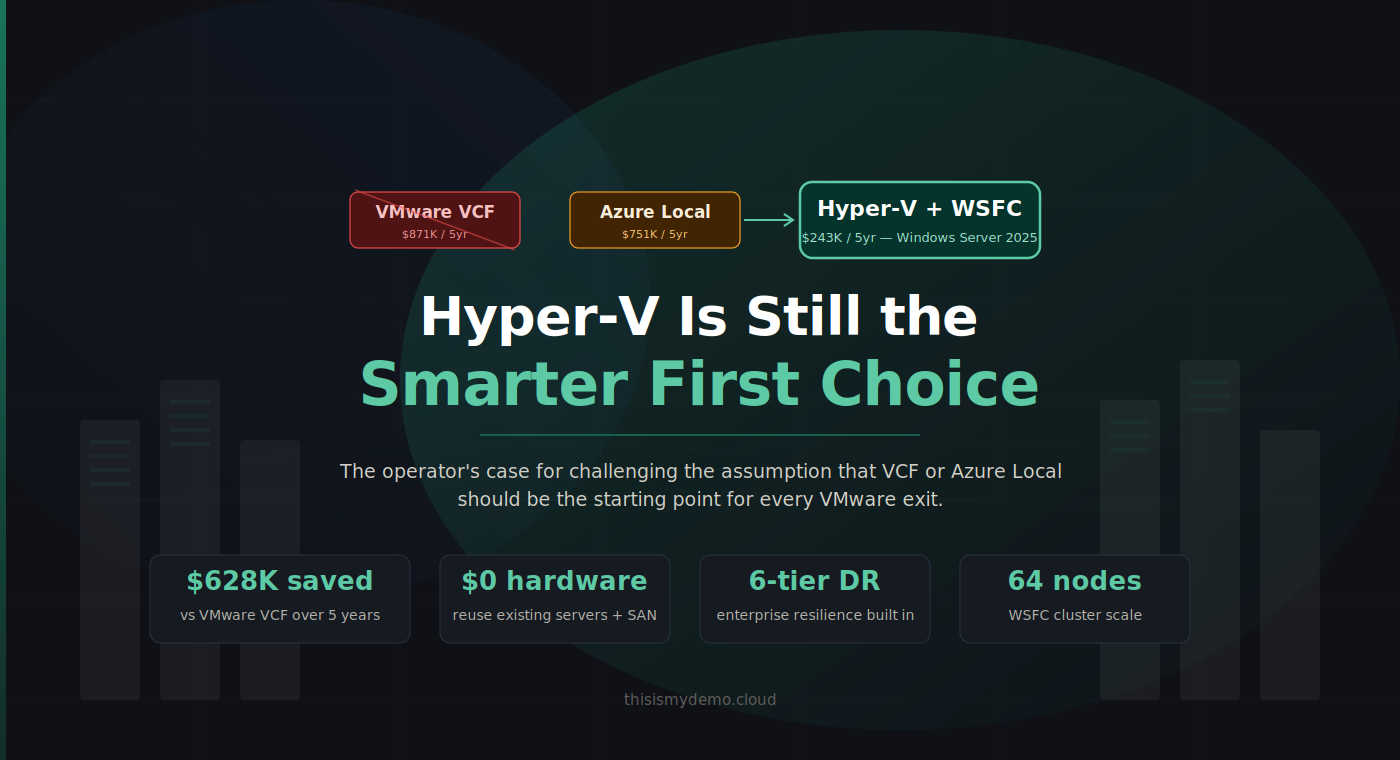
Hyper-V Is Still the Smarter First Choice

Hyper-V Is Still the Smarter First Choice

The operator's case for challenging the assumption that VCF or Azure Local should be the starting point for every VMware exit.

Azure Local is not the default VMware exit path. Neither is VMware Cloud Foundation the unquestioned benchmark it was two years ago. And yet the industry keeps framing the VMware exodus as a binary choice: stay and pay, or move to Microsoft’s preferred Azure-connected platform. Both options serve somebody’s agenda. Neither starts from the question that actually matters to infrastructure operators: what do I need, and what’s the cheapest way to get it without creating new dependencies?
Multi-Site Resilience

Multi-Site Resilience

Hyper-V Replica, Storage Replica, Campus Clusters, and SAN Replication

Post 13 protects your data with backups. This post protects your services with replication.

Backups recover data , you restore a VM from yesterday’s backup and accept the data loss between the backup and the failure. Replication recovers services , your VMs are already running (or can start within minutes) at a secondary site with near-zero data loss. Production environments need both, and the architecture decisions you make here determine whether a site failure is a business disruption or a page in the runbook.

Three-Tier Storage Integration

Three-Tier Storage Integration

iSCSI, Fibre Channel, and SMB3 Integration

Not everything needs to be hyper-converged.

There’s a strong narrative in the infrastructure world that three-tier architecture, separate compute, network, and storage tiers, is outdated. That hyper-converged infrastructure (HCI) is the only path forward. That separating your storage from your compute is a legacy pattern.

That narrative is incomplete.

Three-tier architecture remains the right answer for many workloads and many organizations. If you have an existing SAN investment, if your workloads require deterministic storage performance, if you need storage-level replication for disaster recovery, or if your team has deep storage operations expertise, three-tier isn’t just viable, it’s often superior.