TCO

Hyper-V Is Still the Smarter First Choice

Hyper-V Is Still the Smarter First Choice

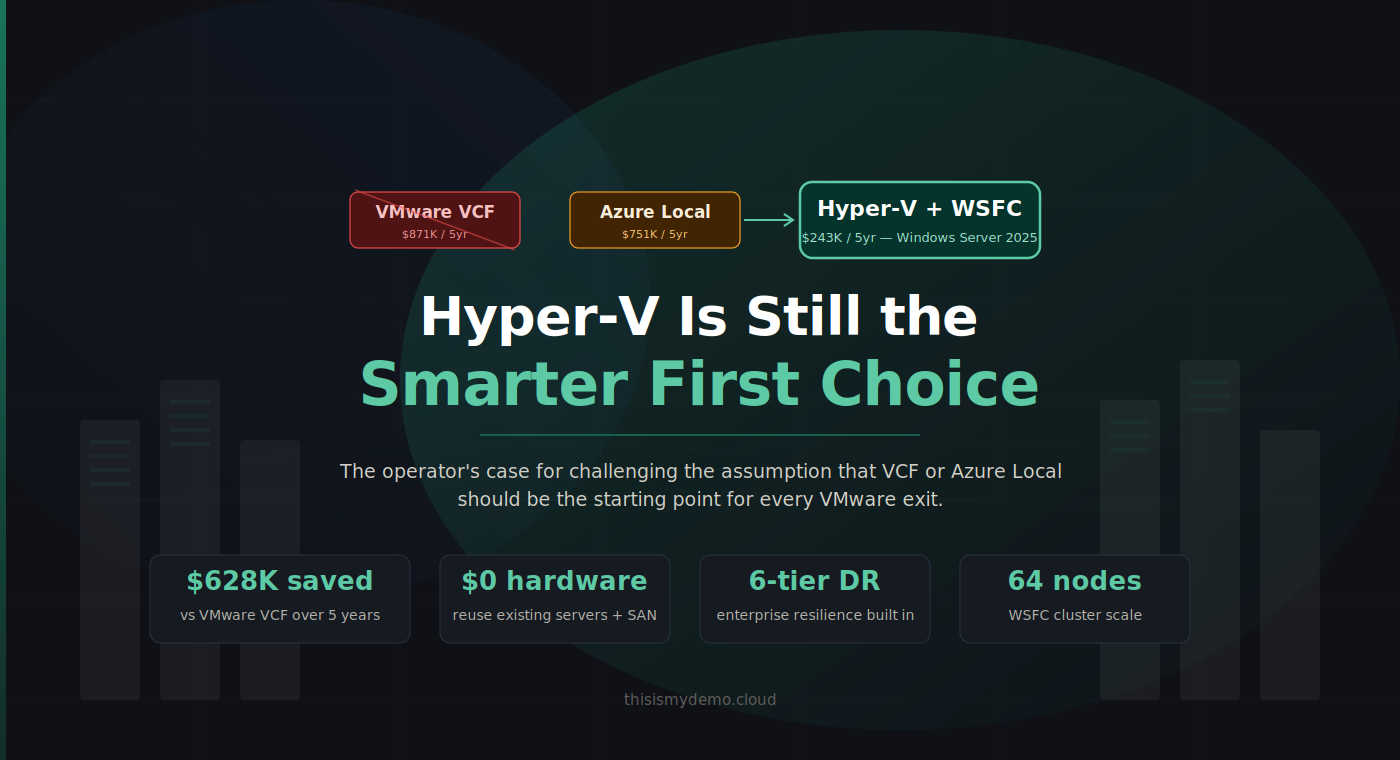
The operator's case for challenging the assumption that VCF or Azure Local should be the starting point for every VMware exit.

Azure Local is not the default VMware exit path. Neither is VMware Cloud Foundation the unquestioned benchmark it was two years ago. And yet the industry keeps framing the VMware exodus as a binary choice: stay and pay, or move to Microsoft’s preferred Azure-connected platform. Both options serve somebody’s agenda. Neither starts from the question that actually matters to infrastructure operators: what do I need, and what’s the cheapest way to get it without creating new dependencies?
What Was Under Your Nose All Along

What Was Under Your Nose All Along

Why Hyper-V Often Fits Better Than VCF 9 or Azure Local

The series started with a simple question: if so many organizations are unhappy with the VMware commercial path they are on, where should they go next?

After twenty posts, the answer is clearer than ever.

For a lot of organizations, the right answer is not “stay where you are and absorb the bill.” It is also not automatically “move to Azure Local because it is Microsoft’s newest answer.” The right answer is often the platform that has been in the rack, in the OS, and in the skill set for years: Hyper-V on Windows Server 2025.

The Real Cost of Virtualization

The Real Cost of Virtualization

TCO Comparison - VMware, Azure Local, and Hyper-V

The invoice arrived, and the meeting quickly followed.

For nearly two decades, the “cost of virtualization” was a line item we grumbled about but accepted. It was the “VMware Tax,” the price of admission for a stable, feature-rich datacenter. But in the wake of the Broadcom acquisition and the subsequent licensing overhaul, that tax has, for many organizations, turned into a ransom.

This isn’t just about price hikes. It’s about a fundamental shift in how infrastructure is consumed. We are forcibly moving from a world of perpetual licenses and optional support to a world of mandatory subscriptions and bundled software stacks.

Welcome to the Hyper-V Renaissance

Welcome to the Hyper-V Renaissance

Why It's Time to Reevaluate Microsoft's On-Prem Champion

Introduction

A Perfect Storm Creates Opportunity

If you’ve been watching the virtualization market over the past eighteen months, you’ve witnessed something extraordinary: a once-stable industry thrown into chaos by a single acquisition. When Broadcom completed its $69 billion purchase of VMware in November 2023, few anticipated how dramatically, and rapidly, the landscape would shift. What followed wasn’t just a pricing adjustment; it was a fundamental restructuring that has sent shockwaves through data centers worldwide.

Beyond the Cloud: 2025 Virtualization Licensing Guide - Part II

Beyond the Cloud: 2025 Virtualization Licensing Guide - Part II

Virtualization licensing just got complicated. With VMware's Broadcom acquisition driving 3x cost increases and Microsoft introducing new subscription models, IT leaders need a clear roadmap. This blog provides the analysis and insights you need to make informed decisions that align with your budget and strategy.

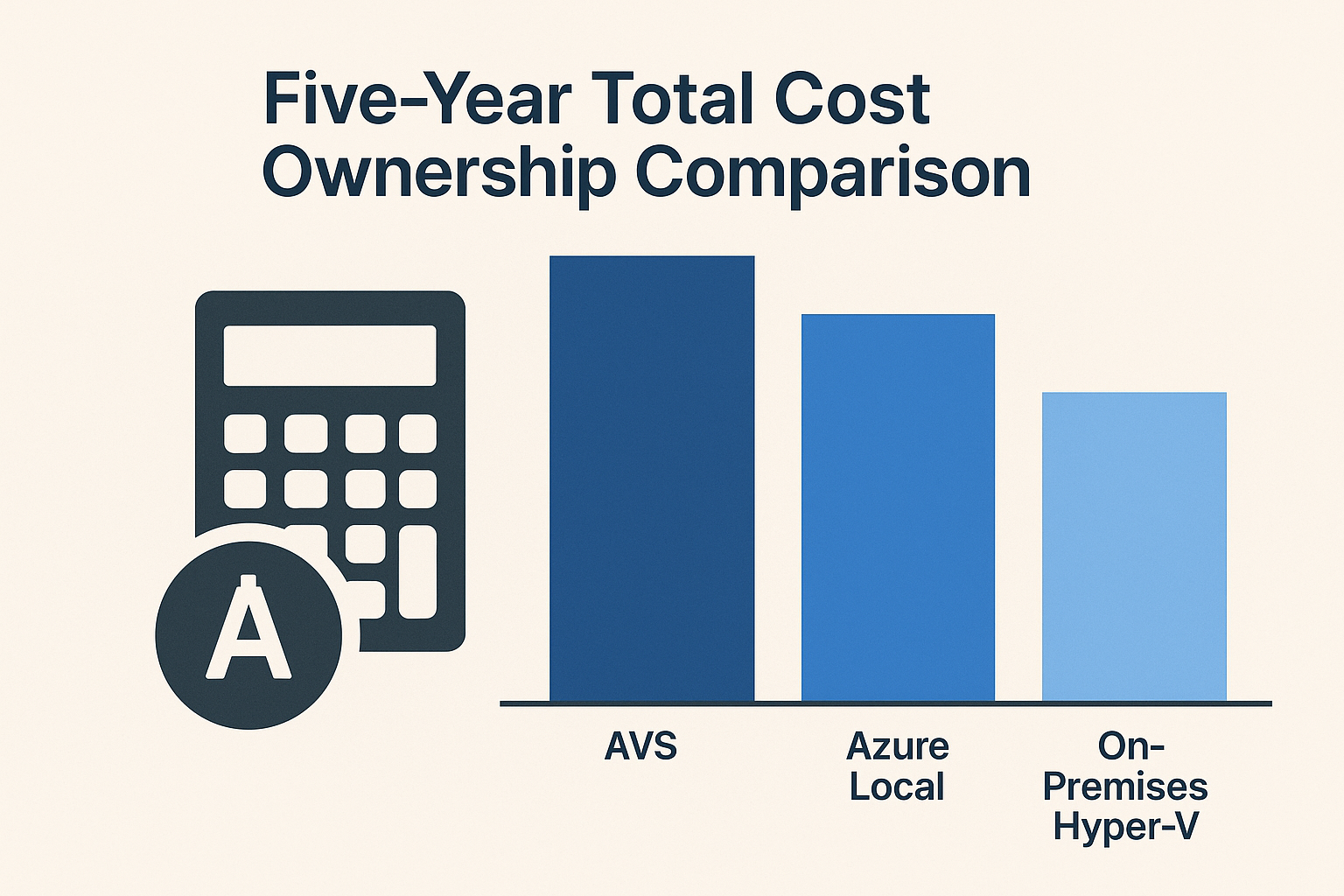
Welcome to Part 2 of our “Beyond the Cloud: The Case for On-Premises Virtualization” series. In our introductory post, we explored why organizations are reconsidering their virtualization strategies post-VMware acquisition. In Part 1, we conducted a detailed five-year Total Cost of Ownership (TCO) analysis comparing Windows Hyper-V, Azure VMware Solution (AVS), and Azure Local, revealing how different cost structures impact long-term budgets.

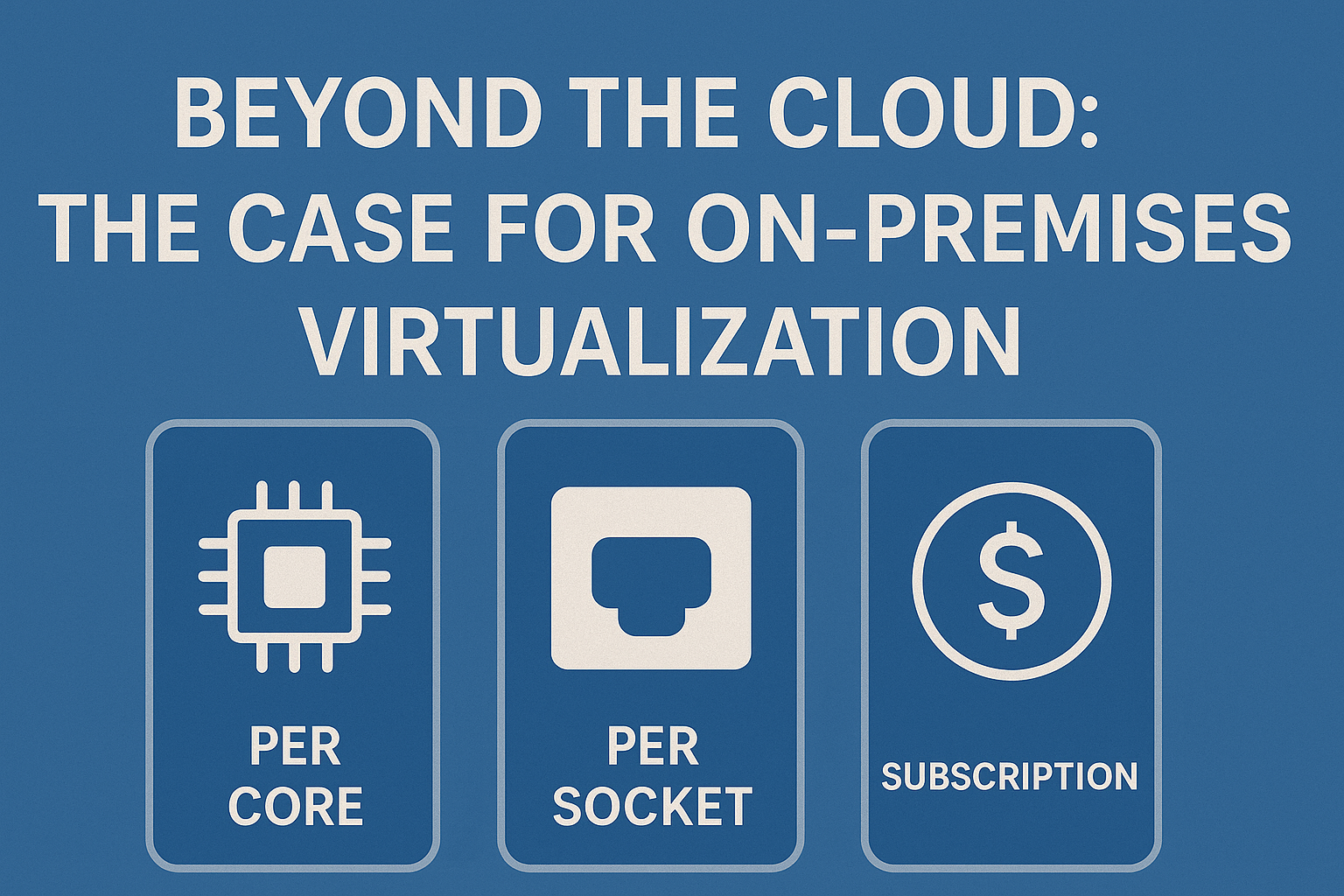
A key factor driving those cost differences was how each platform’s licensing model works. In this follow-up, we will demystify the various licensing models – per core, per socket, and per subscription – and compare how Windows Server 2025 (which reached General Availability in November 2024), Azure Local (formerly “Azure Stack HCI”), and VMware (both on-premises and via Azure VMware Solution) handle licensing. Our goal is to highlight not just the pricing structures, but also where hidden costs can lurk beyond the base license. The tone remains practical and evaluative: this isn’t about picking winners as much as helping IT directors and solution architects understand the financial and operational implications of each model.

Beyond the Cloud: CapEx vs Subscription TCO Analysis - Part I

Beyond the Cloud: CapEx vs Subscription TCO Analysis - Part I

Which stack is cheapest over five years for a 100 VM footprint? A detailed TCO analysis of Hyper-V, Azure VMware Solution, and Azure Local.

Introduction

In our previous blog post, we explored why organizations are reconsidering their virtualization strategy post-VMware and highlighted the often-overlooked value of Windows Server Failover Clustering with Hyper-V. Now, in this first follow-up post of the "Beyond the Cloud: The Case for On-Premises Virtualization" series, we dive into the financial side of that decision. Specifically, we will compare the five-year Total Cost of Ownership (TCO) for three possible platforms to run a 100-Virtual Machine (VM) workload: