WSFC

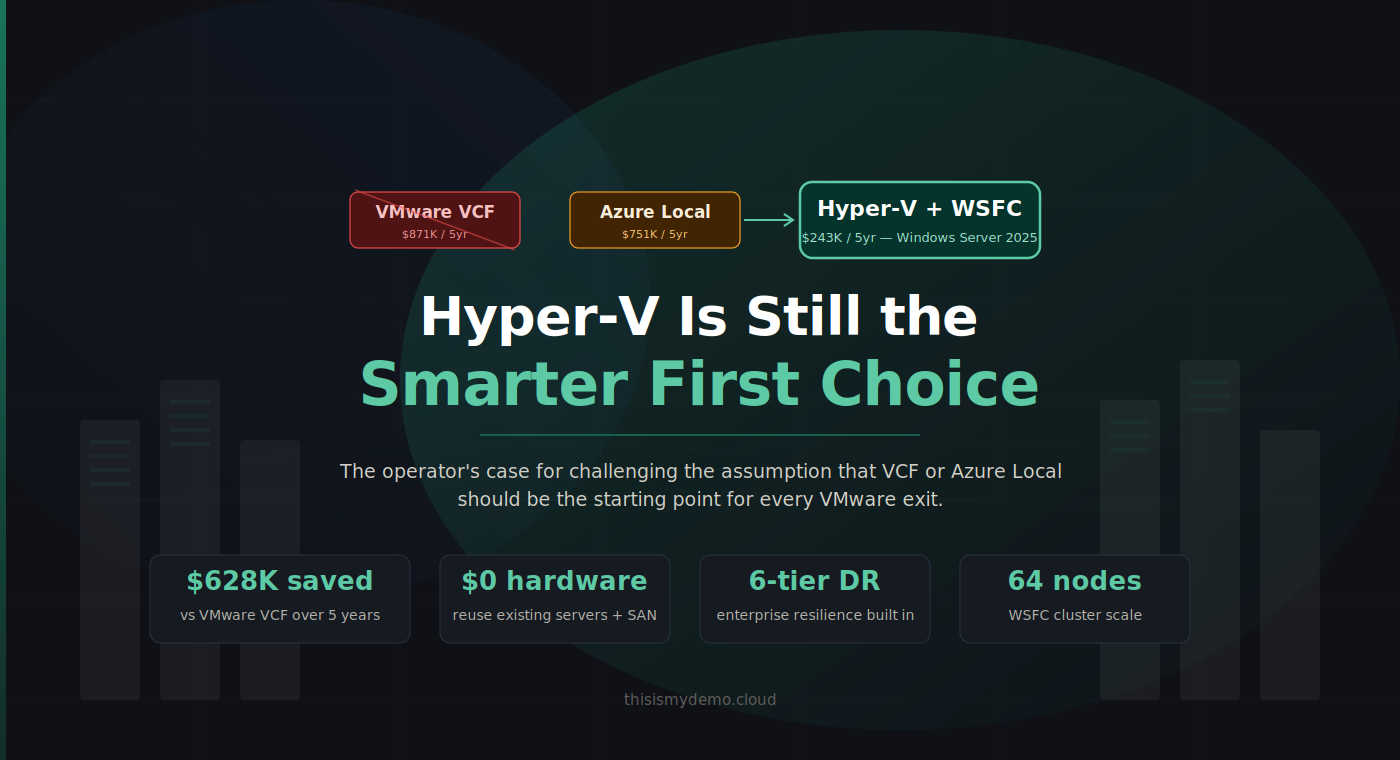
Hyper-V Is Still the Smarter First Choice

Hyper-V Is Still the Smarter First Choice

The operator's case for challenging the assumption that VCF or Azure Local should be the starting point for every VMware exit.

Azure Local is not the default VMware exit path. Neither is VMware Cloud Foundation the unquestioned benchmark it was two years ago. And yet the industry keeps framing the VMware exodus as a binary choice: stay and pay, or move to Microsoft’s preferred Azure-connected platform. Both options serve somebody’s agenda. Neither starts from the question that actually matters to infrastructure operators: what do I need, and what’s the cheapest way to get it without creating new dependencies?

WSFC at Scale

WSFC at Scale

Cluster Sets, Cluster-Aware Updating, and the 64-Node Architecture

A two-node cluster is an architecture decision. A 64-node cluster is a lifestyle choice.

Posts 5 through 8 built your first cluster. Posts 9 through 15 hardened, monitored, secured, and protected it. This post asks the question that comes next: what happens when you need more?

Scaling Hyper-V is also where the economics need to stay honest. The goal is not to recreate every premium reference architecture just because it exists. The goal is to scale a platform that is already cheaper than the VCF path and often more flexible than an Azure Local design that assumes new hardware and a new recurring bill.

Powerful, Practical, Proven: Why WSFC and Hyper‑V Deserve a Second Look

Powerful, Practical, Proven: Why WSFC and Hyper‑V Deserve a Second Look

Virtualization is a cornerstone of modern IT infrastructure, and while VMware vSphere has long been a leader, Microsoft's Windows Server Failover Clustering with Hyper-V offers a compelling alternative for organizations seeking cost-effective, high-performance virtualization.

Why Choose Windows Server Failover Clustering (WSFC) with Hyper‑V Over VMware

Virtualization is a cornerstone of modern IT infrastructure, and VMware vSphere has long been a leader in this space. However, Microsoft’s Windows Server Failover Clustering (WSFC) with Hyper‑V offers a compelling alternative for organizations seeking a cost-effective, high-performance virtualization platform. In this post, targeted at IT professionals, we’ll explore why WSFC with Hyper‑V is a strong alternative to VMware – emphasizing the ability to leverage existing hardware (reducing new hardware costs), the performance benefits of Hyper‑V, available management tools, feature comparisons with VMware, and a look at licensing and cost differences.

Beyond the Cloud: Rethinking Virtualization Post-VMware

Beyond the Cloud: Rethinking Virtualization Post-VMware

How Hyper-V with Windows Server Clustering Stays Relevant in an Azure-First World

From My Perspective as a Microsoft Azure Hybrid MVP – Two Decades in Microsoft Hybrid & HCI

I write this blog as a longtime Microsoft advocate with two decades of hands-on experience—from early Hyper-V in 2008 to today’s Azure Local. This series aims to highlight the potential of Windows Server Failover Clustering (WSFC) as a viable alternative for organizations transitioning away from VMware, especially in light of Broadcom’s acquisition. While I value Azure’s Cloud and Hybrid offerings, I believe Microsoft’s current messaging overlooks WSFC’s capabilities in providing cost-effective, high-availability solutions. Through this blog, I intend to shed light on WSFC’s strengths and advocate for its consideration in modern IT infrastructures.